

Introduction
Modern enterprises rarely operate with a single order intake channel. Orders can originate from web stores, partner systems, EDI networks, or even file-based submissions such as Excel. The real challenge for organizations is not just capturing these orders, but orchestrating a controlled, automated, and financially compliant end-to-end order lifecycle.

Microsoft Dynamics 365 Finance & Operations (D365FO) provides a strong foundation to act as a central orchestration engine for such scenarios. When designed correctly, it can seamlessly integrate multiple order sources, validate inventory and financial constraints, automate warehouse execution, and ensure accurate invoicing with minimal manual intervention.
This blog presents a generic, reusable, and Microsoft-aligned technical architecture for implementing an end-to-end Order-to-Cash (O2C) process in D365FO.
Business Requirement Overview
Organizations typically require an ERP-driven solution that can:
- Accept orders from multiple external sources
- Identify and track the origin of each order
- Validate inventory availability at order intake
- Enforce customer credit limits and overdue invoice rules
- Prevent invalid orders from reaching the warehouse
- Integrate with external warehouse systems
- Automatically confirm delivery and post invoices
The objective is to achieve automation, scalability, auditability, and financial governance without over-customizing the core ERP system.
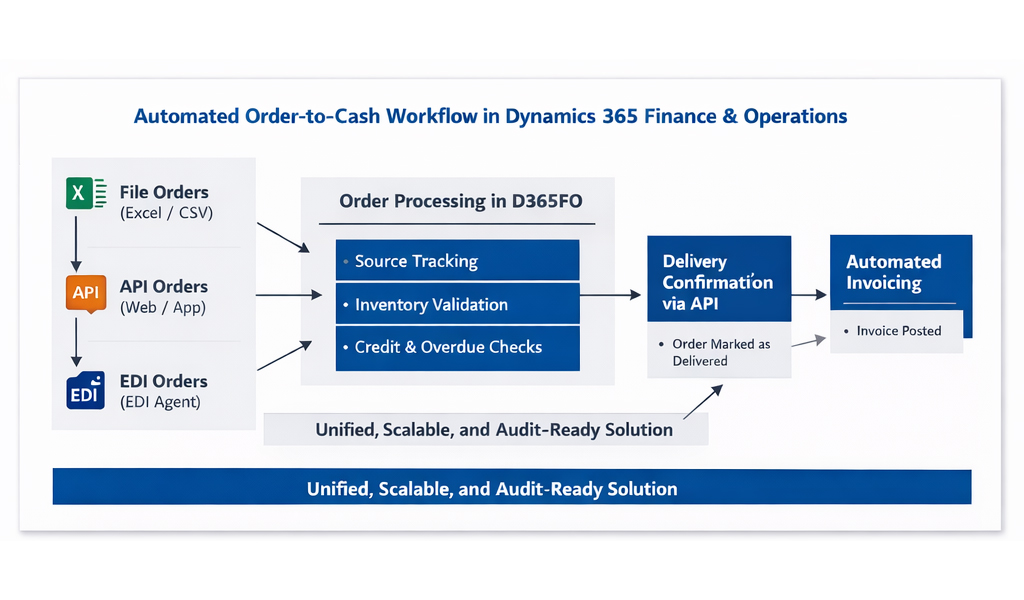
Multi-Source Order Ingestion Architecture
[Multi-source order ingestion architecture diagram showing File, API, and EDI sources feeding into D365FO]
To support modern commerce models, D365FO must handle multiple inbound integration patterns while maintaining a unified processing flow.
Source 1: File-Based Orders (Excel / CSV)
File-based integration is common where upstream systems or partners cannot integrate in real time. Orders are received in structured formats such as Excel or CSV and processed through a controlled import mechanism.
Key characteristics:
- Batch-driven ingestion
- Schema and data validation
- Duplicate order prevention
- Error handling and logging
This approach is ideal for scheduled or low-frequency order submissions.
Source 2: API-Based Orders
API-based integration enables real-time order creation directly in D365FO. This pattern is commonly used for e-commerce platforms, mobile applications, and internal systems.
Key characteristics:
- Near real-time processing
- Immediate validation
- High scalability
- Suitable for high-volume digital channels
Source 3: EDI-Based Orders via Integration Agents
In B2B environments, orders are often exchanged using EDI standards. An EDI agent receives partner messages, transforms them into a canonical format, and submits them to D365FO via APIs.
Benefits include:
- Standardized partner communication
- High reliability
- Reduced manual intervention
- Proven scalability in supply chain ecosystems
Unified Order Creation and Source Tracking
[Sales order creation flow with order source tagging]
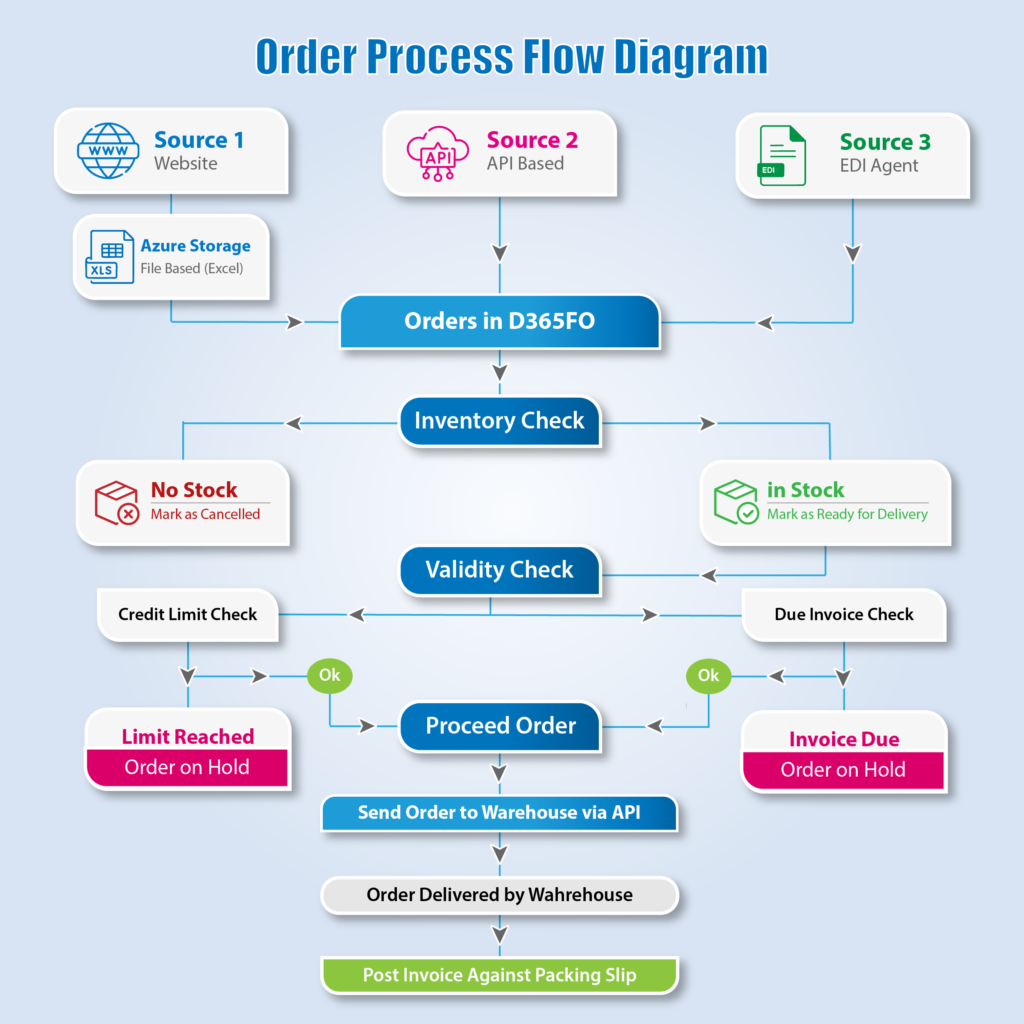
Regardless of the inbound channel, all orders follow a single standardized order creation process in D365FO.
Each order is tagged with an Order Source indicator, enabling:
- Source-based reporting and analytics
- Operational visibility
- Downstream process control
- Easier troubleshooting and audits
This design follows Microsoft best practices by using extensions rather than modifying standard D365FO logic.
Inventory Validation at Order Logging
[Inventory availability check during sales order creation]
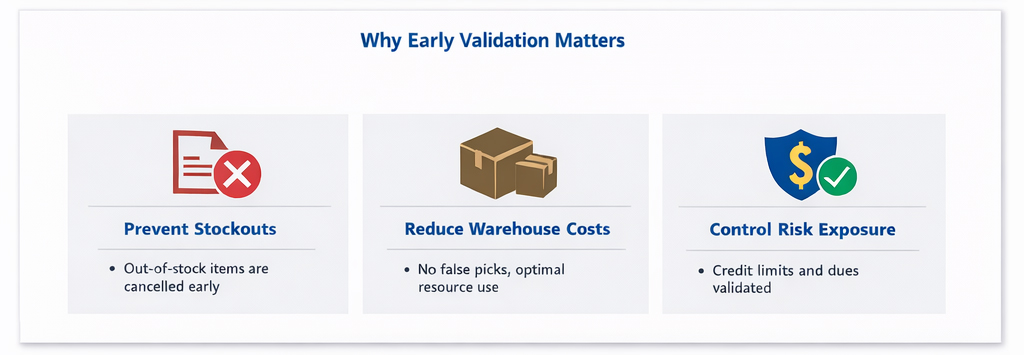
Inventory availability is validated at the time of order creation.
- If inventory is available, the order proceeds
- If inventory is not available, the affected line or order is marked as cancelled
By handling inventory exceptions early:
- Invalid orders never reach the warehouse
- Picking and packing inefficiencies are eliminated
- Customer expectations are managed proactively
Order Lifecycle and Status Management
[Order lifecycle states from Created to Invoiced]
A controlled order lifecycle ensures transparency and governance throughout the process. A typical lifecycle includes:
- Created
- Ready for Delivery
- On Hold (Financial / Credit)
- Sent to Warehouse
- Delivered
- Invoiced
Status transitions are system-driven and fully auditable.
Financial and Credit Control Validations
Credit Limit Validation
Before an order is released to the warehouse, the system validates the customer’s credit limit.
- If the credit limit is exceeded, the order is placed on hold
- Once payment is received, the order can be automatically released
This prevents financial overexposure while maintaining operational flow.
Overdue Invoice Validation
The system also checks for overdue customer invoices.
- If overdue invoices exist, the order is stopped
- Further processing resumes only after financial obligations are cleared
This validation ensures strong financial discipline and compliance.
Warehouse Integration via API
[ERP to Warehouse API integration flow]
A scheduled batch process in D365FO identifies orders that:
- Have valid inventory
- Are financially approved
- Are not on hold
Eligible orders are sent to the warehouse system via API for:
- Picking
- Packing
- Delivery execution
This decoupled integration approach allows independent scaling of ERP and warehouse systems.
Delivery Confirmation and System Feedback
[Warehouse delivery confirmation sent back to D365FO]
Once delivery is completed:
- The warehouse system sends a confirmation to D365FO via API
- The sales order is marked as Delivered
- Packing slips are confirmed automatically
This real-time feedback loop ensures accurate order status visibility.
Automated Invoicing
[Automated invoicing batch process in D365FO]
A standard D365FO batch job posts invoices against confirmed packing slips.
Key outcomes:
- Orders move to Invoiced status
- Revenue is recognized correctly
- Manual invoicing effort is eliminated
This step leverages standard D365FO capabilities combined with robust orchestration.
Key Benefits of the Architecture
- End-to-end automated Order-to-Cash process
- Multi-channel order intake
- Early inventory and financial validation
- Warehouse-safe execution
- Reduced manual intervention
- High scalability and extensibility
- Full audit and compliance support
Conclusion
This architecture demonstrates how Dynamics 365 Finance & Operations can act as a central orchestration platform for complex order processing landscapes. By combining multiple integration patterns, early validations, warehouse automation, and standard financial controls, organizations can build a resilient and scalable order fulfillment process.
The approach is generic, reusable across industries, and fully aligned with Microsoft-recommended best practices—making it suitable for enterprises looking to modernize and scale their Order-to-Cash operations.
Operational Monitoring and Exception Handling
In any automated order processing architecture, operational visibility is critical. While the process is largely system-driven, exceptions must be detected and handled proactively.
Key monitoring aspects include:
- Failed order imports (file, API, or EDI)
- Inventory shortages beyond acceptable thresholds
- Orders placed on financial or credit hold
- Warehouse integration failures
- Delivery confirmation delays
D365FO batch job history, infologs, and integration logs play a vital role in identifying issues early. Alerts and dashboards can be configured to notify operational teams when manual intervention is required, ensuring continuity without breaking automation.
Error Handling and Reprocessing Strategy
A robust error-handling strategy ensures system resilience.
Best practices include:
- Storing failed inbound messages with detailed error context
- Allowing safe reprocessing without duplicate order creation
- Separating technical errors from business validation failures
- Maintaining idempotency for API-based integrations
This approach minimizes downtime and avoids data inconsistencies across integrated systems.
Security and Compliance Considerations
Security is a core design principle in multi-system integrations.
Important considerations:
- API authentication and authorization
- Role-based access control within D365FO
- Secure handling of customer and financial data
- Audit trails for order status changes and financial postings
By leveraging D365FO security frameworks and secure integration patterns, organizations can meet internal and regulatory compliance requirements.
Scalability and Performance Design
As order volumes grow, the architecture must scale without compromising performance.